Research Question: What boundaries of legal personhood ought to exist for nonliving entities versus living nonhuman entities?
Why is it important?
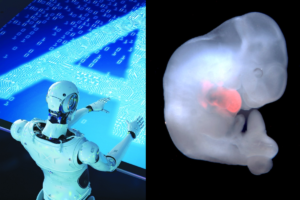
The categories for legal personhood recognition are becoming increasingly difficult to discern as technology advances in fields of biochemistry producing human-animal CRISPR babies, and computer science developers of artificial/spontaneous intelligence.
This research will demonstrate what boundaries of personhood exist for nonliving entities versus nonhuman entities, and why these must remain the same going into the future.
Analyst Staker showcases an essential component that must be shared between all entities regardless of physical form or lack of cognitive agency, and this is based on a legal doctrine of standing. “Standing operates as a gateway to the legal system… (such precedent which) could eventually lead to ‘the full recognition of non-human beings as subjects of rights’ (Staker)”. In other words, standing is what grants humans the right to attempt a judicial resolution of a controversy. This component of personhood is binding from government interference, such as in America’s judicial system where as long as you can provide sufficient stake, you are free to seek out the appropriate legal channels.
Staker goes on to explain why little expansion of personhood boundaries has been accomplished for living nonhuman entities, in regards to standing. “US courts have allowed animal species (though not individual animals) to be named as plaintiffs in several cases… pursued otherwise in a ‘narrow’ procedural sense”. The limitation of personhood individually for these animals benefits the specific controversy of one species, without the massive complications that arise from granting personhood to all species.
About developing personhood for nonliving entities, these boundaries have been set by those of history such as, “slaves, women, and children… (who were viewed as being) considered property,” (Glenn). Until one makes the categorical leap from “rightless” thing (or property) to becoming a rights holder, now a legal entity fully visible to the courts (Athens), they will not be able to exercise their personhood in society. This was such the case for corporations, municipalities, and ships, all nonliving entities, which eventually achieved given rights as persons.
In the battle for the standing of non-living entities, researcher Coleman points to the court case of Citizens United v. Federal Election Commission [2010] where corporations were granted minimal standing. Coleman notes, “any legal distinction between individual and corporate speech in the public sphere”, had been eroded.
More distinctions between these boundaries have been described in Chan’s article, The Boundaries of Legal Personhood: How Spontaneous Intelligence Can Problematise Differences between Humans, Artificial Intelligence, Companies, and Animals. For example, when taking into account the criteria of personhood for nonliving human entities (like corporations), Chan found that “the corporate structure of a company is a person of a legal fiction”, it has no physical form, it has a controlling mind (CEO, the board of directors), it is an artifact of a particular place and jurisdiction by good nature of its contributors. Rather than broadly granting legal rights to all entities that fall under these classifications, these factors help in drawing distinctions of attributes to consider in nonliving entities before granting personhood. Such distinctions prove useful when contrasting why different boundaries exist for nonliving entities versus living nonhuman entities.
Likewise, Chan’s analysis also showed some key distinctions for the basis behind the attribution of personhood to living non-human animals. By the articles account these include; higher-order animals (resembling more human characteristic), respect/recognition of “the moral agency of animals” (default human position), their physical appearance, their lack of cognitive agency/awareness, their ability to realistically exercise rights (not just on paper). Just as before these criteria are a baseline that should be tested against any scenario involving living non-human entities, and will help explain why these boundaries for living non-human entities differ from non-living entities.
Transcript:
Is-Rael: What comes to mind when you think of the boundaries of legal personhood that should exist for nonhuman living entities vs nonliving entities?
Hannah: I think it is interesting in general the idea of legal personhood for entities other than humans whether they be living or non-living. I would have to be honest that I don’t know enough about legal personhood to have a confident answer, but I do have a few general ideas about the topic. Firstly, if legal personhood were to apply, I would assume that more rights would be awarded to nonhuman living entities than nonliving entities. I would consider this to be so because to me personhood is what defines a person. Therefore, I would assume we would compare a nonhuman living thing to a nonliving thing as to which is more of a person. Since there are a lot of similarities between non-human living entities and humans, such as needing to breathe, eat, drink water, etc, they would most likely have more personhood. Even more so, animals would probably have more personhood than plants. And plants more than microorganisms, etc. in general though, the idea of applying personhood to nonliving entities and non-human living entities seems wrong as they are not humans and do not relate to personhood as we do. Personhood is somewhat of a made-up concept from my small understanding. I’m not sure how far personhood goes, but it doesn’t make sense to me to try to apply personhood to animals, for example, who have their way of living and surviving.
Is-Rael: Do you think this is an interesting or important question why or why not?
Hannah: Yes I would say this is interesting to think about. The idea of animals or plants having rights has pros and cons. I see where animal activists, vegetarians, or vegans could argue why animals deserve rights and why they’d Gould be protected. At the same time, it makes me question if it would be fair to do so, as these animals wouldn’t get to weigh in on the conversation of their rights because we can’t communicate with them. It seems like applying personhood would more so be people applying rights that humans felt nonhuman living entities and nonliving entities would want. I would however say in terms of the importance that this is pretty low on the totem pole. I would say and I’m sure others agree that there are far more important issues currently going on than whether we should apply personhood to non-human living entities and non-living entities.
Is-Rael: Based on my preliminary research and analysis, this is what I have found so far: (Kiroshort)
Hannah: Animals should have some rights or they can be exploited. But at the same time, there are limitations because they don’t have a say in the rights that they’re given. You just have to be careful. If they didn’t have any rights it would be free for all.
(Consent to use Transcript was given)
Citations:
Glenn, Linda MacDonald. “A Legal Perspective on Humanity, Personhood, and Species Boundaries.” The American Journal of Bioethics, vol. 3, no. 3, 2003, pp. 27–28.
Coleman, Leo. “Corporate Identity in Citizens United: Legal Fictions and Anthropological Theory.” Political and Legal Anthropology Review, vol. 37, no. 2, 2014, pp. 308–328.
Chen, Jiahong, and Burgess, Paul. “The Boundaries of Legal Personhood: How Spontaneous Intelligence Can Problematise Differences between Humans, Artificial Intelligence, Companies and Animals.” Artificial Intelligence and Law, vol. 27, no. 1, 2018, pp. 73–92.
Athens, Allison Katherine. “An Indivisible and Living Whole: Do We Value Nature Enough to Grant It Personhood?” Ecology Law Quarterly, vol. 45, no. 2, 2018, p. 187.
Staker, Alexia. “Should Chimpanzees Have Standing? The Case for Pursuing Legal Personhood for Non-Human Animals.” Transnational Environmental Law, vol. 6, no. 3, 2017, pp. 485–507.